

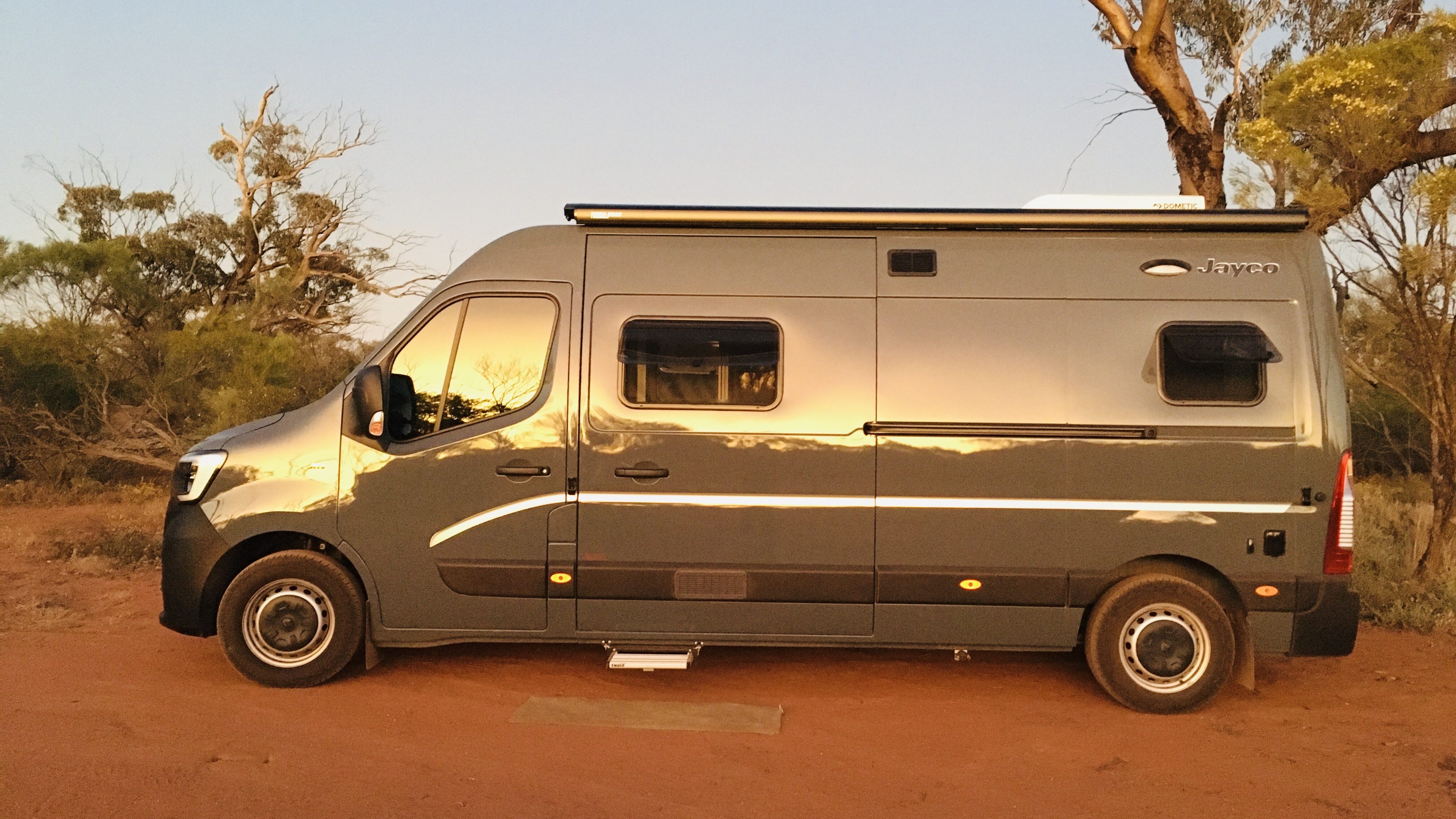
Little Bus is a 2022 Renault Master Van converted by Jayco into a Campervan. (The RM19-1)
It is our sanctuary, our habitat, our home, our car. It is fully self contained but as we generally move on everyday we have the opportunity to recharge and refill as we go so it’s more suitable for moving rather than staying in one place for longer than a few days.
Features
It does have the 100L freshwater tank, 60L grey tank, 20L black tank integrated into the toilet, we also carry 35L of fresh drinking water in Jerry cans, this we use for everyday drinking and cooking.
It’s a small 2.3L turbo diesel, and we get around 9.2L per 100km mixed touring and around town.
Its grey and 6.1M long (19 feet) and 2.7m high and we can get from the driver’s seat to the bed without going outside, a real benefit when it’s raining.
It’s easy to drive, though the automated manual gearbox gets a little bit of getting used to, it still has a clutch plate but no clutch pedal and you can manually change gears. It has no park gear only drive, reverse and neutral, sitting on 100-110km/h on cruise is a breeze without the engine straining, no excessive road noise or rattling.
The seats are really comfy both drivers and passenger have lumbar support and armrest and adjustable, as per the norm. The driver’s seat is height adjustable.
Visibility is great, the reverse camera is especially useful.
A Fiamma awning covers the passenger side and sliding door. It’s easy to put up and down, if it is blowing a fair wind, we don’t risk damaging it and generally leave the awning closed and try to seek natural shade were possible.
Issues
The main issues we have had is not with the Renault or vehicle side but with the Jayco build.
First it can get mighty hot especially if you park with the shower side in the sun, very little venting and no insulation between the skin of the vehicle and the wooden panelling so the airspace becomes superheated,
This led to the shower walls buckling and bowing as the adhesive changed in the heat, a bit concerting as the little bus was only 2 days old when we noticed it and it was only 24 degrees at the time… so awaiting warranty repair.
The dometic main cabin aircon struggled to maintain the temperature on a 36-degree day when running it gave out cool air but not cold, temp inside the van was 48 degrees at 4pm in the afternoon, The Sirocco II fans help thought it was cooler outside the van than inside!
Later with more experience we learn to use the ventilation mode prior to aircon, but being as with most vans the aircon only operates on 240V so out the bush off grid it’s of no use.
The other only issue has been the winegard aerial socket has come apart inside the switch now being useless so we can’t use the TV aerial to watch TV, Oh well we still have DVDs
Oh, and I think the quality of the Furrion TV and Media system, though they do work, is pretty ordinary,
Dust suppression is quite good with only a minor amount of dust getting in around the seals at the back and under the seats, coming out the vents and onto the cushions, not too bad but noticeable. We have resealed everything where hoses come in but just can’t find where it’s coming in…. I’m thinking the water point has two vents but only one hose… Is that it?
Later I discovered that under the body are two plastic plates that seal the structural components of the chassis- they had holes in them so sealing up a bit and packing the channels with insulation has significantly reduced if not eliminated this problem.
Issue: Water and dust – ABS sensor warning light coming on
So, we had done some corrugations, and some dust and then the next day it rained not too heavy as we drove… and all of a sudden three warning lights came on, the spanner, the ABS symbol (brake drum) and the ECS symbol Skidding car). Along with the warning messages “check ABS, Check ECS Check hill assist” It seems the most likely cause is a wheel sensor, probably got some dust and water in it…. It went out eventually and hasn’t come back on yet.
Once home we sprayed all the connections with Lanolin spray to help keep water and dust out. Since then, there have been no problems.
Modifications
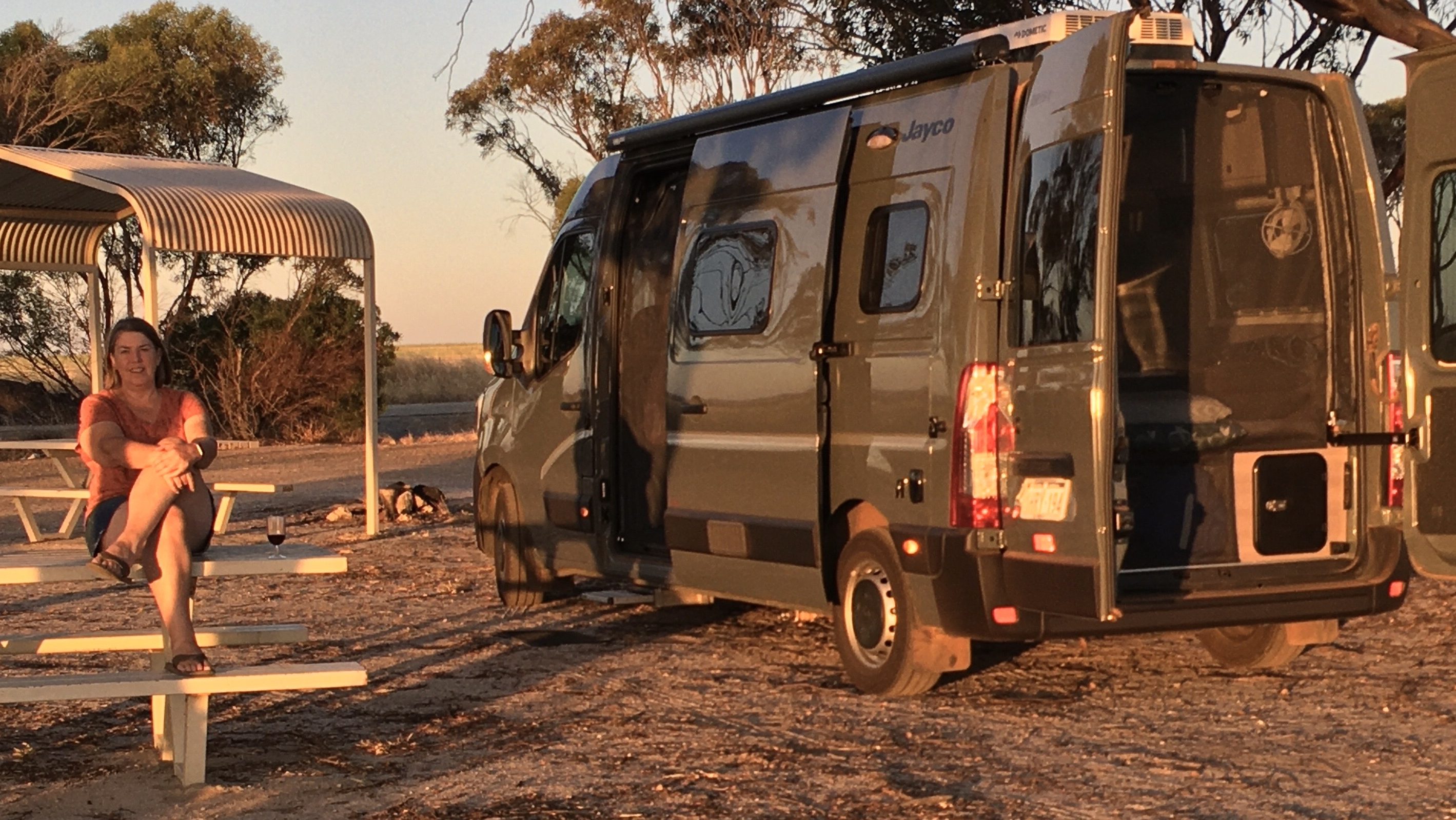
We installed flyscreen netting at a cost of $900” for both screens across the rear and in the sliding door, it had to be a custom fit because of the door rail at the top and the locking plate at the bottom, there is a gap at the top and if you want to close the door you have to unzip the bottom a bit. As he said “It can’t be fly proof but will be fly resistant.
The screens are heavy duty mesh with solid zips, it’s edges are pushed under the door seal. After the recent 3-week trip we had no real issues with fly’s or mozzies getting in. The real benefit is allowing the little bus to vent by keeping the doors open to maximise cooling from the breeze.
There is no facility for charging phones/cameras etc from USB so we have installed a series of auxillary points- The cigarette lighter in the rear is now a double USB charge point running of the vehicle battery (turns of with the ignition) whilst opposite I have installed another dual usb outlet and a 12V power socket in case we need to run compressors, another fridge or anything, these run of the house battery controlled by separate switches.
We will cover more on Little Bus as we travel on our adventures, so I hope you stick with us.
 That Campervan Life
2 responses to “Reviewing ‘Little Bus’ Renault Master RM-19 Campervan”
Nicely said , I can concur my 2023 Nov van has the same qualities 😊
LikeLike
Thanks Darrel, still love it and have just come back again from a short weekender, Little Bus just makes it so easy to do that
LikeLiked by 1 person